+8615820889696
 Info@cowint.com



Introduction: DTF reshaped textile printing. UV DTF is now redefining the boundaries of “printing on anything.” It didn‘t reinvent the wheel—it created a magical “AB film” that extends UV printing’s precision and convenience to virtually every hard surface.
Behind every glossy custom tumbler lies the core secret of UV DTF technology: AB film. It serves both as your design’s cradle and your transfer‘s engine. Understanding AB film’s composition, working principles, and position within the UV DTF workflow is the first and critical step to unlocking this technology‘s full potential. This article provides an in-depth analysis of the complete UV DTF AB film technology landscape.
1. Technical Overview of UV DTF AB Film: A Film vs. B Film
A standard UV DTF transfer consumable system consists of two precisely engineered functional films—A-Film and B-Film.
A-Film is a transparent PET film with a UV ink-receptive coating, serving as the print carrier directly receiving UV printer output. When a print job begins, A-Film acts like a blank canvas awaiting the artist, accepting UV ink droplets from the printheads. After printing, UV light instantly cures the ink, fixing the pattern permanently at room temperature.
B-Film is a transparent protective layer laminated over the freshly printed A-Film, typically through cold lamination, forming a sandwich structure: A-Film at the bottom, the protected and pressure-activated design in the middle, and B-Film on top. B-Film’s core functions include becoming the design‘s new carrier during transfer, protecting the design from scratches and contamination during storage and shipping, and providing a stable pressing surface for evenly adhering the design to the target object.
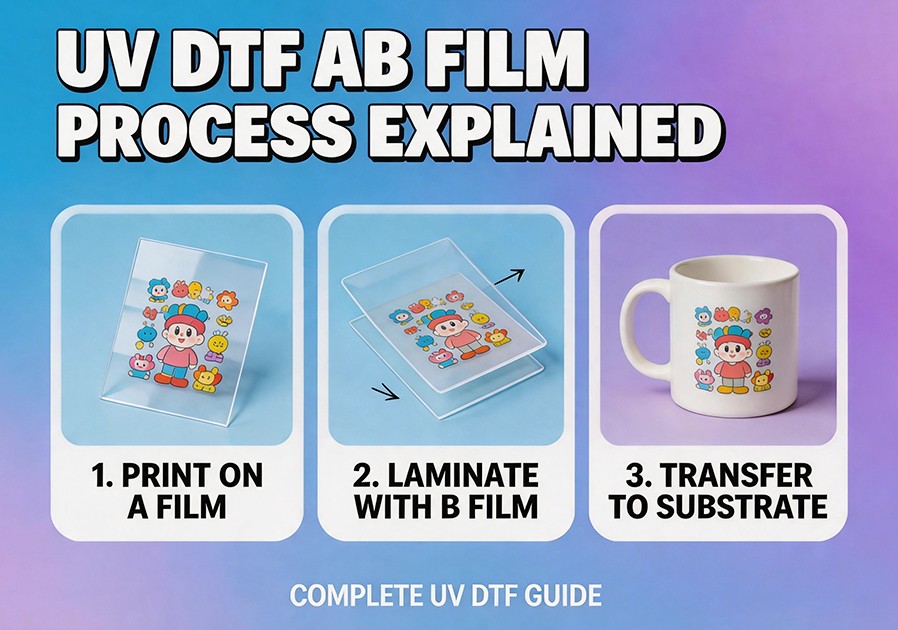
The AB Film Collaborative Workflow can be summarized as five steps: “Print → Laminate → Peel A-Film → Hand Pressure Apply → Peel B-Film.” This micro-scale AB film system completes one precise transformation from the digital virtual world to the physical real world.
2. UV DTF Consumable Types, Selection, and Innovations in 2026
Based on performance and application scenarios, new AB film materials typically fall into several categories: standard universal grade, high-stretch curved grade, high-adhesion dark-color grade, gold/silver foil transfer grade, and writable label-grade.
In 2026, leading global AB film suppliers have made foundational breakthroughs in the AB film space. Roland DGA‘s new-generation UV DTF transfer system features specially optimized A-Film and B-Film, with official data showing up to twice the adhesion of competing systems—the B-Film’s new multi-layer laminated structure doubles transfer peel workflow production efficiency.
3. UV DTF Transferable Substrate List: Value-Creating Application Carriers
UV DTF works on virtually any hard surface. It can transfer to virtually any hard, non-porous substrate, covering glass, metal, plastics, wood, ceramics, leatherette, and stone. Common forms include rigid flat panels, curved surfaces, and irregular 3D shapes—with unlimited color requirements covering transparent, translucent, and opaque options.
Below is the core UV DTF transferable product list prioritized by commercial potential:
Tier 1 — Best Commercial Practices (Largest Market Demand): Stainless steel tumblers, glass mugs, ceramic mugs, polycarbonate/TPU phone cases, metal USB drives/stylus pens, glass candle jars, sliding acrylic keychains, wooden postcards.
Tier 2 — Lucrative Niches (Lower Competition, Higher Unit Price): Metal badges and medals, leather wallets and journal covers, compact powder cases, golf accessory markers, amber spirit bottles, camping flasks, laptop/tablet cases, pet ID tags, plastic employee badges.
Tier 3 — Vertical Industry Customization (Blue Ocean, High Expertise): Medical device control buttons and indicators, injection-molded part functional labels, model train or drone fuselage decals, keycaps and mouse shells, dental appliance identification markers, museum special exhibit labels, coffee roaster control panels, industrial cabinet doors.
4. Emerging UV DTF Application Trends in 2026
The integration of “special effect UV DTF“ with holographic and metallic foiling is a significant development trend in 2026 UV DTF applications. Manufacturers have integrated foil stamping functionality into printing systems, applying a layer of metallic foil over traditional UV ink patterns—elevating simple promotional products to near-luxury brand status.
Another highlight is the democratization of ”3D embossed UV DTF.“ Premium UV DTF systems can now deposit vertical layers of raised varnish with tens to hundreds of microns of height, creating both visual and tactile 3D impacts ideal for high-end brand recognition and luxury corporate gifting