+8615820889696
 Info@cowint.com



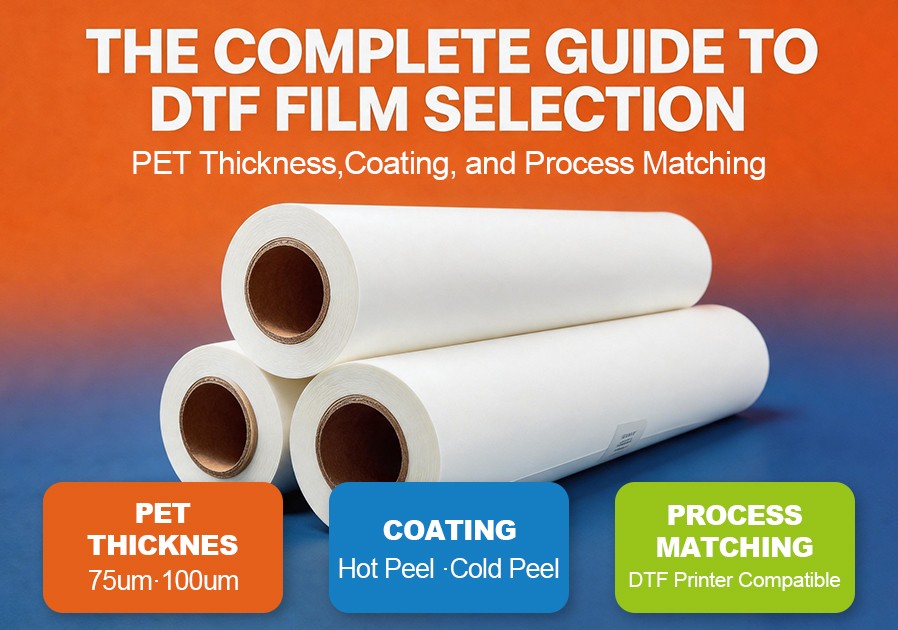
Introduction: When you search for “DTF film,” you‘re not just looking at different brands—you’re facing a decision matrix about thickness, coating type, peel method, and compatibility with your specific printer. The right choice can mean the difference between smooth production and constant troubleshooting.
DTF transfer film is the starting point of the entire DTF workflow—and one of the most underestimated variables in successful DTF printing. Low-quality generic film with inconsistent coating will cause random adhesion failures that no amount of heat press adjustment can fix. This guide covers PET thickness, coating types, hot vs cold peel selection, and printer compatibility.
1. PET Thickness: Balancing Stability vs Flexibility
PET thickness defines the thickness of the polyester base layer in microns—a mechanical property, not a surface performance spec. Common specifications include 75µ and 100µ.
75µ Film: Thinner, more flexible, lighter. More nimble in tight press gaps. Recommended for printers with smaller nozzle heights for precise ink placement. Ideal for lightweight fabrics prioritizing hand feel.
100µ Film: Thicker, stiffer, more stable. Less deformation under tension. Recommended for printers with larger nozzle heights to prevent head strikes. Ideal for heavy fabrics and high-volume continuous production.
PET thickness does not control ink absorption, color density, or edge sharpness—those are controlled by the ink receiving layer. Choose thickness based on mechanical requirements, not visual expectations.
2. Cold Peel vs Hot Peel: Choosing Your Method
Cold Peel Film: Wait for the design to cool completely (about 1-2 minutes) before peeling. Provides more stable adhesion, more forgiving for beginners, recommended for most applications demanding wash durability.
Hot Peel Film: Peel immediately while warm. Faster production speed, ideal for high-efficiency environments. Demands precise timing and technique.
For beginners, cold peel film is strongly recommended for its stability and forgiveness. For established producers maximizing throughput, hot peel offers faster workflow once mastered.
3. Coating Quality: The Underestimated Variable
DTF film coating quality determines ink absorption, color vibrancy, and release behavior.
Uniform Coating. Consistent coat weight across rolls and batches. Non-uniform coating causes random adhesion failures with no pattern.
Proper Release Behavior. The coating must release the cured ink-powder layer cleanly at the appropriate peel window, leaving no residue.
Anti-Static Properties (Optional). Prevents static buildup, reducing dust attraction and registration errors—especially valuable for printers operating in dry environments.
Consumable Compatibility. Quality DTF film works with various DTF ink brands without expensive proprietary lock-in. Greater compatibility means lower operating costs and more flexible supply chains.
4. Quick Troubleshooting for Film Selection
| Problem | Possible Cause | Solution |
|---|---|---|
| Film shifting or jamming during print | PET thickness mismatched to printer | Check nozzle height; match appropriate thickness |
| Random adhesion failures | Inconsistent coating quality | Switch to verified, brand-name film |
| Film difficult to peel | Wrong peel timing or coating failure | Confirm peel type; check coating |
| Banding or blurry detail | Film too thick or unstable feed | Try thinner film; clean feed rollers |
| Misalignment in dry environments | Static causing dust attraction | Choose anti-static film; increase humidity |
5. Film Storage Best Practices
Store DTF film in a cool, dry environment away from direct sunlight and extreme temperatures. Humidity fluctuations cause PET substrate expansion, affecting feed stability. Avoid heavy stacking to prevent deformation.