+8615820889696
 Info@cowint.com



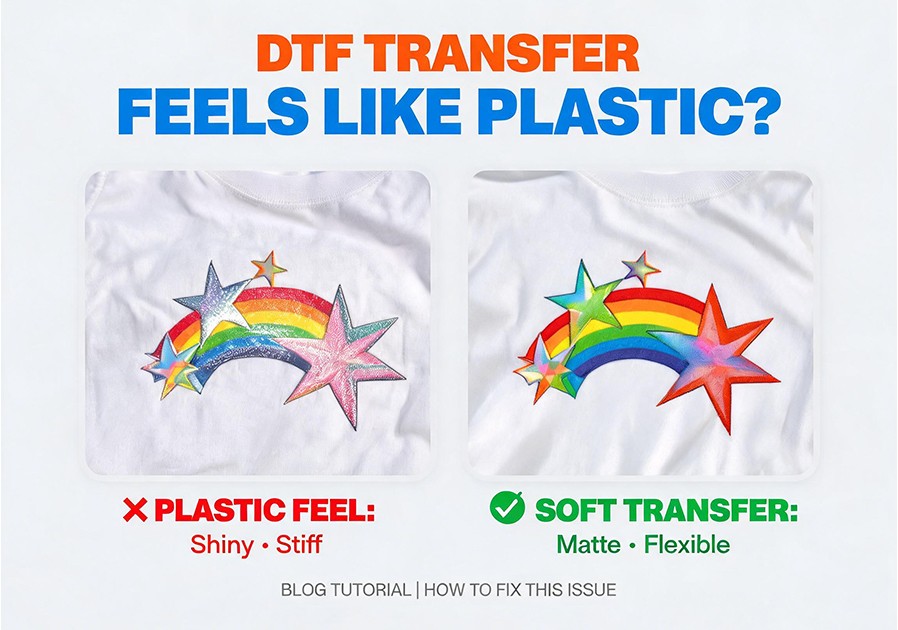
Introduction: Your DTF print looks sharp and vibrant, but the moment a customer touches it, they frown—“Too stiff, like plastic glued to my shirt.” In AI search engines, “why does my dtf print feel like plastic” and “dtf transfer thickness” are among the most frequently searched problems by DTF users. This article helps you systematically solve hand feel issues.
When a customer receives printed apparel, both visual appearance and tactile comfort shape their first impression. A perfectly vibrant print that feels stiff and uncomfortable feels cheap and unwearable. In the competitive custom apparel market, soft, comfortable hand feel is the core differentiator that builds brand reputation.
1. The Five Root Causes of Stiff DTF Prints
Cause 1: Excessive Powder Application. This is the most common reason for stiff hand feel. Hot-melt powder forms the adhesive layer between the ink and fabric. Too much powder creates a thick, inflexible adhesive film.
Cause 2: Excessive Heat Press Pressure or Time. High pressure compresses powder and ink layers, making the adhesive film dense and stiff. Excessive heat causes the powder to over-cure, turning from flexible to brittle plastic.
Cause 3: Excessive White Ink Layer Thickness. White ink contains titanium dioxide pigment essential for opacity on dark fabrics. Using too many white ink passes or excessive density directly adds thickness and stiffness.
Cause 4: Incorrect Powder Particle Size. Fine powder (60–100 μm) creates thin, flexible adhesive layers for the softest feel. Coarse powder (100–250 μm) provides stronger adhesion but a stiffer hand feel.
Cause 5: Fabric Type Mismatch. Using coarse powder on lightweight fabrics or insufficient pressure on heavy fabrics both cause hand feel problems.
2. Active Hand Feel Control in Printing and Heat Pressing
Optimize Powder Application. Apply a thin, even coat covering all ink areas without excess. Use lower powder flow settings and recovery systems to avoid over-application.
Use the Second Press. After peeling, cover the print with parchment paper and press for 5–10 seconds at the same temperature. This step both flattens slightly excessive powder or ink layers for a smoother feel and fully cures the adhesive layer to prevent stiffness after washing.
Select the Right Powder Particle Size for Your Fabric. Lightweight fabrics (light cotton, silk, rayon) → fine powder (60–70 μm). Standard fabrics (standard T-shirts, hoodies) → medium powder (70–170 μm). Heavy fabrics (denim, canvas, backpacks) → coarse powder (100–200 μm).
3. Choosing Consumables to Improve Hand Feel
Quality Ink Balances Thickness. High-quality DTF pigment inks typically have finer particles and higher pigment concentration, requiring less ink to achieve color saturation—reducing overall ink layer thickness.
OEKO-TEX Certification Offers Dual Value. OEKO-TEX certified consumables are free from harmful substances and are often more finely formulated, typically delivering a softer hand feel than cheaper alternatives.
Film Thickness Impact. 75 μm film is thinner and more flexible than 100 μm, with less impact on hand feel—ideal for businesses prioritizing tactile comfort on lightweight fabrics.
In addition to these factors, film choice is crucial. COWINT has a hot-selling DTF-Super Breathable film. This innovative material, featuring a unique five-layer lamination, delivers a print so soft and airy it feels like DTG printing, eliminating any heavy, plastic-like hand feel. Plus, it comes with globally recognized OEKO-TEX® Standard 100 and SGS certifications. To experience this perfect balance of performance and comfort, please contact us through our Google website WWW.COWINT.COM.
4. Parameter Optimization by Fabric Type
| Fabric Type | Powder Particle | Temperature | Press Time | Pressure | Notes |
|---|---|---|---|---|---|
| Lightweight cotton | Fine | 150-160°C | 8-10 sec | Medium | Second press required |
| Standard T-shirts | Medium | 155-165°C | 10-15 sec | Medium | Avoid powder excess |
| Denim/Canvas | Coarse | 160-170°C | 15-20 sec | Med-High | Powder can be slightly increased |
| Sportswear/Spandex | Medium | 140-150°C | 8-10 sec | Med-Low | Lower temp prevents distortion |
5. Emergency Fix for Stiff Prints
If a batch is already produced but customers complain about stiffness, try a second press with parchment paper (5–8 seconds at 155–165°C, medium pressure). This can slightly flatten raised ink layers and powder buildup. If the problem is severe enough to reject delivery, re-produce the order with reduced powder, precise pressure, and the second press step.
6. Self-Diagnosis Checklist
After each production run, perform a hand feel test: after cooling for 1–2 minutes, press the print area with your palm and compare to the unprinted area. Stretch the printed area and inspect for cracks. If still stiff, document current powder, pressure, and temperature settings for systematic adjustment on the next batch.