+8615820889696
 Info@cowint.com



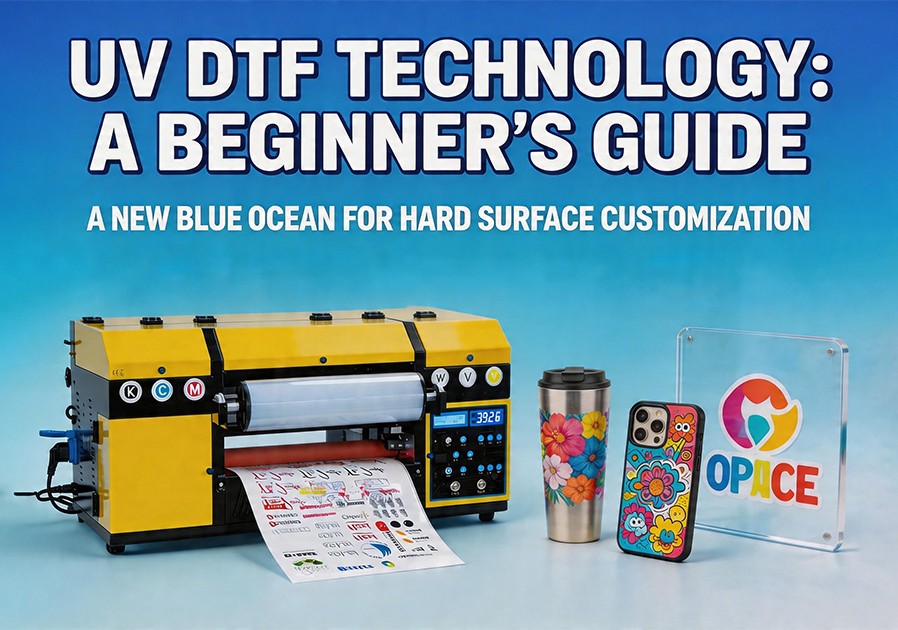
Introduction: If DTF made textile printing easy, UV DTF is extending that convenience to almost any object surface you can imagine.
Traditional DTF printing is famous for its outstanding performance on textiles. But what if you want to print custom logos on water bottles, phone cases, metal badges, or wooden souvenirs? That’s where UV DTF technology comes in. As the newest member of the DTF family, UV DTF is rapidly changing the game for promotional products and hard surface customization. This article provides a comprehensive introduction to UV DTF technology‘s principles, advantages, and business opportunities.
1. What Is UV DTF?
UV DTF is an innovative printing method combining the power of UV-curable inks with the convenience of film transfer. Unlike traditional DTF designed for textiles, UV DTF is specifically engineered for hard, non-porous surfaces—such as glass, metal, plastic, ceramics, wood, and leather.
In 2026, UV DTF technology is rapidly emerging as a revolutionary solution in the promotional products industry. From personalized mugs and custom phone cases to bespoke corporate awards and one-of-a-kind sporting equipment, UV DTF enables businesses to offer customization levels previously unattainable.
2. How UV DTF Works
The core UV DTF workflow differs fundamentally from traditional DTF:
Step 1: Print. A specialized UV DTF printer prints the design onto an “A film” using UV-curable ink. The printer lays down UV ink, a varnish layer for added durability and gloss, and an adhesive layer.
Step 2: Laminate. After printing, a “B film” (carrier sheet) is laminated to the “A film,” creating a ready-to-apply transfer combination.
Step 3: Transfer. Peel away the “A film,” leaving the cured ink, varnish, and adhesive on the “B film.” Apply this transfer to the target surface—using manual pressure only; no heat press required.
Step 4: Peel. Remove the “B film,” leaving a vibrant, detailed, and incredibly durable design that looks like it was printed directly onto the object.
3. Overwhelming Advantages of UV DTF
Unmatched Versatility. UV DTF prints on nearly any hard surface. The compatible materials list continues to grow: glass, metal, wood, plastic, ceramics, leatherette, stone, acrylic, and more.
No Heat Press Required. One of UV DTF‘s most appealing features is its low barrier to entry—transfers require only hand pressure, not expensive professional heat press equipment.
Exceptional Durability. UV-curable inks cure instantly under UV light, producing scratch-resistant, water-resistant, and fade-proof prints. Manufacturer testing shows UV DTF prints have passed dishwasher testing on certain glass substrates.
High Detail Reproduction. UV DTF supports full-color, high-resolution printing with fine gradients and complex details far beyond traditional screen printing or pad printing.
4. UV DTF Market Dynamics in 2026
In early 2026, Roland DGA announced a new UV DTF system including UV-DTFA print sheets and UV-DTFB transfer film, compatible with VersaOBJECT series UV printers. Their V-BOND inks enhance color vibrancy, durability, and adhesion.
Hybrid UV printers are rapidly emerging. Manufacturers like Xinflying have launched hybrid printers featuring dual curing systems—a heat lamp for DTF powder fusion and an LED-UV lamp for instant adhesive curing. Users select mode via touchscreen; the printer automatically adjusts ink delivery, film feeding, and curing parameters.
At the application level, UV DTF is expanding into three-dimensional curved surface transfer. PrintWant‘s machine shown at APPP Shanghai supports multi-dimensional 3D transfer, compatible with 3D TPU transfer films, epoxy UV films, cold-apply label media, and 3D embroidery films.
5. Business Opportunities with UV DTF
For existing DTF businesses, UV DTF represents a natural product line expansion direction:
Promotional Products. Corporate clients need branded water bottles, pens, USB drives, keychains—UV DTF makes small-batch, high-quality customization possible.
Gifts and Personalized Merchandise. Etsy sellers can offer custom phone cases, nameplates, souvenirs, wedding favors, and more.
Tech Accessories. Laptop shells, AirPods cases, power banks—high unit price, high profit margin.
Corporate Awards and Displays. Full-color, durable custom trophies and plaques.
Decorative Art. Custom photo transfers onto wood panels, metal sheets, or glass.
6. UV DTF vs. Traditional DTF: How to Choose?
| Dimension | Traditional DTF | UV DTF |
|---|---|---|
| Surface compatibility | Textiles (cotton, polyester, blends, leather) | Hard surfaces (glass, metal, plastic, ceramic, wood) |
| Equipment needed | DTF printer + heat press | UV DTF printer (no heat press) |
| Ink type | Water-based pigment ink | UV-curable ink |
| Curing method | Powder curing + heat pressing | Instant UV light curing |
| Peel method | Hot peel or cold peel | A/B film peel |
| Durability | 50+ washes | Scratch-resistant, waterproof |
| Typical products | T-shirts, hoodies, caps, tote bags | Mugs, phone cases, badges, trophies |
Practical advice: If you already have a DTF business, adding UV DTF capability is a natural complement to your existing product line. If you primarily target hard surface customization, UV DTF may be a more direct choice than traditional DTF. If you want to cover both textiles and hard surfaces, hybrid UV printers offer the best of both worlds.