+8615820889696
 Info@cowint.com



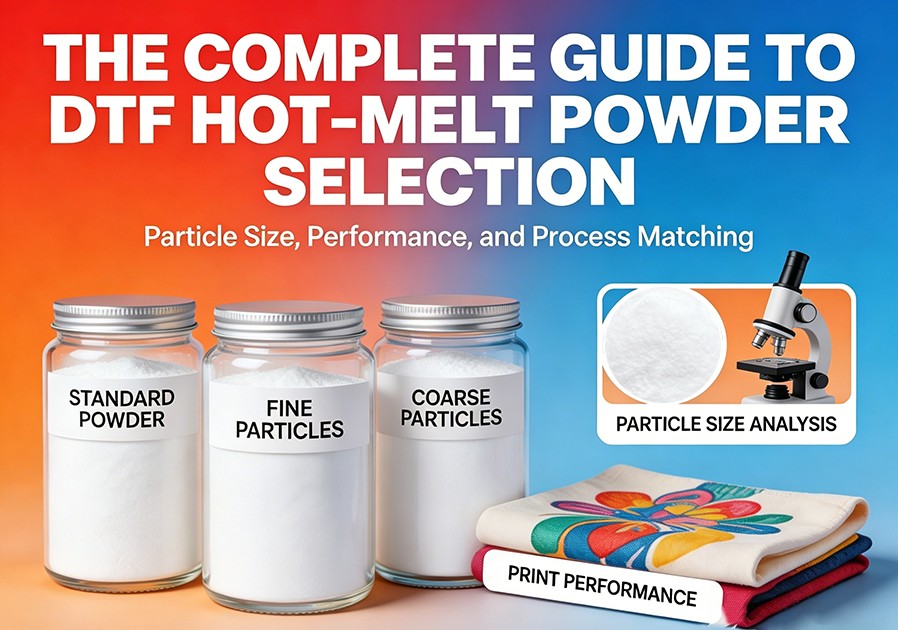
Introduction: In the “invisible three layers” of DTF printing, hot-melt powder is the most overlooked yet most critical component.
Many DTF practitioners focus their attention on printers and inks, overlooking the decisive impact of hot-melt powder on final product quality. Hot-melt powder is the “invisible adhesive“ that connects the ink layer to the fabric — it determines whether the print remains intact after 50 washes, whether the hand feel is soft as cotton or stiff as plastic, and how well it adheres to different fabrics. This article provides a complete guide to particle size selection and process optimization for DTF hot-melt powder.
1. The Foundation: Why TPU Is the Industry Standard
DTF hot-melt powder is typically based on thermoplastic polyurethane (TPU). TPU has become the material of choice because it achieves the perfect balance of flexibility, adhesion, and wash durability. TPU melts cleanly without burning and provides strong adhesion across various fabrics, including cotton and polyester blends.
Some premium hot-melt powders feature German-produced, Swiss-engineered polyurethane adhesive formulations like Itex PU75, delivering outstanding melting uniformity, bond strength, and durability.
2. Particle Size: The Science of Coarse vs. Fine Powder
Particle size distribution is the key variable determining final print performance. Different particle sizes suit different design complexities, fabric types, and production scenarios. Suppliers like MAXDTF classify DTF hot-melt powder into Fine, Medium, and Large particle grades, allowing selection based on application preference and production workflow.
Fine Powder (0–70 μm / -80 mesh). Flour-like in texture. Designed for applications requiring smoother surface feel and refined edge definition. Commonly selected for detailed designs and lightweight garments. Fine powder distributes evenly, melts quickly, and forms a thin, flexible adhesive layer. Ideal for small text, fine lines, and intricate artwork. Offers the softest hand feel — perfect for lightweight fabrics.
Medium Powder (70–170 μm / -150 mesh). Salt-like in texture — your go-to for everyday jobs. Medium powder balances adhesion, softness, and durability, suitable for both manual and automated application. Works for cotton, mixed fabrics, hoodies, sportswear, and most general projects.
Coarse Powder (120–240 μm+). Sugar-coarse in texture. Designed for applications requiring stronger bonding behavior or thicker ink layers, typically selected for specific fabric types or design requirements. Coarse powder offers the deepest fiber penetration, strongest grip, and longest lifespan. Ideal for heavy fabrics like denim, canvas, backpacks, and uniforms. However, coarse powder creates a firmer hand feel and is not recommended for fine details or lightweight fabrics.
3. Melting Characteristics and Process Parameters
Hot-melt powder performance depends on melting behavior during curing and heat pressing. DTF hot-melt powder supports stable melting and predictable adhesion under common production conditions.
Standard Powders. Melting temperature 145–160°C (293–320°F), press time 8–12 seconds.
Low-Temperature Powders. Melting point 125–135°C (257–275°F), suitable for heat-sensitive fabrics.
High-Temperature Powders. Some powders have melt ranges as low as 105–118°C, with heat pressing at 280–330°F for 8–10 seconds, reducing scorching risk and improving adhesion control and production cycles.
Different applications require different curing parameters. For example, one brand‘s standard cure specification calls for 115°C for 2–3 minutes, while others operate at 135–155°C for 10–20 seconds. This underscores the importance of internal testing and process validation.
4. Color Choice: White vs. Black Powder
White hot-melt powder is the standard choice for most applications, performing excellently on light-colored fabrics and standard prints.
Black anti-sublimation powder is gaining significant traction in 2025–2026. Black powder features a specialized anti-sublimation function — forming a dark barrier layer during heat pressing that prevents dye migration from dark fabrics into light-colored prints. This is critical for printing bright designs on dark polyester garments, effectively solving the color contamination issue caused by dye migration.
5. Practical Guide to Hot-Melt Powder Selection
Key considerations when selecting hot-melt powder:
Design complexity — Fine powder for detailed artwork; medium or coarse for bold designs
Ink layer thickness — Thicker ink layers require stronger adhesion (coarse powder)
Fabric characteristics — Heavy fabrics need coarse powder; lightweight fabrics need fine powder
Production workflow preference — Compatibility of automatic powder shakers with different particle sizes
Recommendations by fabric type:
| Fabric Type | Recommended Particle Size | Melt Temp | Press Time | Key Consideration |
|---|---|---|---|---|
| Lightweight cotton/polyester | Fine (0–70μm) | 145–160°C | 8–12 sec | Maintain soft hand feel |
| Standard T-shirts/hoodies | Medium (70–170μm) | 145–160°C | 8–12 sec | Balance adhesion & softness |
| Denim/canvas | Coarse (120–240μm) | 260–330°F | 10–15 sec | Deep fiber penetration |
| Sportswear/spandex | Fine or Medium | 135–155°C | 10–20 sec | High elasticity requirement |
| Dark polyester | Medium + black anti-sublimation | 145–160°C | 8–12 sec | Prevent dye migration |
| Leather/PU | Medium (70–100μm) | 150–160°C | 10–12 sec | Avoid surface roughness |
6. Common Problems and Solutions
Problem: Prints crack or peel after hand or machine washing.
Possible causes: Improper powder selection, insufficient curing, or fabric-powder mismatch.
Solutions: Verify that the selected powder‘s melting temperature matches your curing equipment; increase curing time or temperature; use TPU-based elastic powder for high-stretch fabrics.
Problem: Prints feel stiff or plastic-like.
Possible causes: Excessive powder application, overly coarse particle size, or excessive ink layer thickness.
Solutions: Reduce powder quantity; switch to fine powder for lightweight fabrics; optimize ink density settings in RIP software.
Problem: Uneven powder distribution leading to inconsistent adhesion.
Possible causes: Inconsistent manual powdering technique, powder clumping, or incorrect automatic shaker settings.
Solutions: Consider investing in an automatic powder system for more consistent results; store powder in low-humidity environments to prevent clumping; clean and maintain powder equipment regularly.
Problem: White prints on dark polyester turn yellow.
Possible causes: Dye migration (polyester dyes sublimate during heat pressing and migrate into the print).
Solutions: Use black anti-sublimation powder to create a barrier layer between print and fabric; reduce heat press temperature; shorten pressing time.
Problem: Powder leaves residue buildup in shakers or ovens.
Possible causes: Low-quality powder containing tin compounds or other additives.
Solutions: Choose clean-formula powders free from tin compounds and phthalates, like premium products such as ProPeel.