+8615820889696
 Info@cowint.com



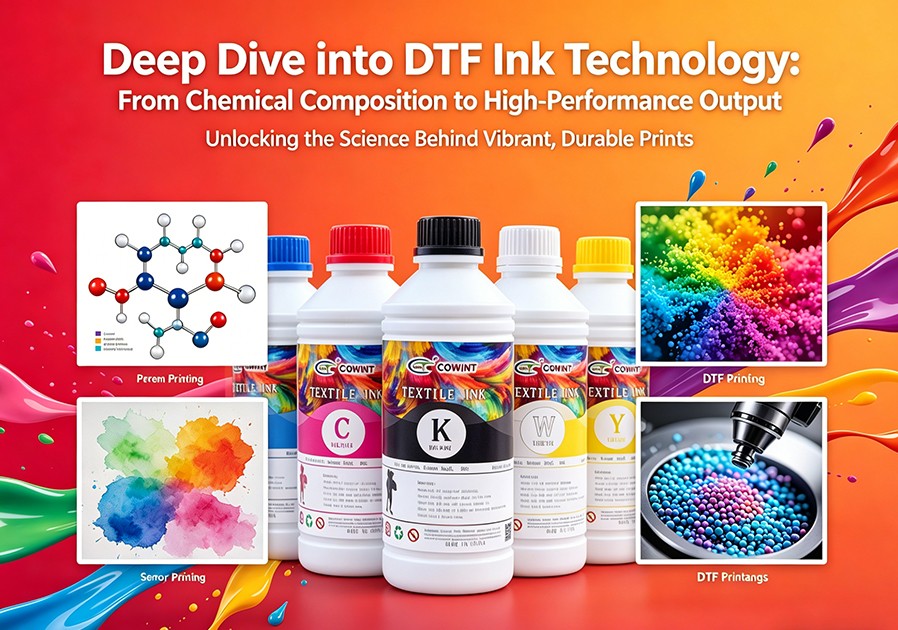
Introduction: In DTF printing, competitiveness begins with every breakthrough in ink chemistry.
Within the DTF system, ink is the most underestimated core element. The printer provides the skeleton, the film serves as the carrier, but ink—especially white ink—is the “soul” determining final output quality. This article explores DTF ink chemistry, technology evolution, quality control standards, and future innovations, explaining why choosing the right ink is the primary prerequisite for high-quality DTF printing.
1. Foundation of DTF Ink: Water-Based Pigment Ink
Unlike plastisol inks (containing PVC and phthalates) used in screen printing, DTF inks are fundamentally water-based pigment inks. They contain no harsh chemicals or solvents associated with traditional methods; cleanup requires simple, readily available cleaning solutions, not volatile organic compounds.
Water-based pigment inks suspend fine pigment particles in an aqueous carrier. When printed onto PET film and subjected to high heat, water evaporates and pigment particles bond securely to fabric fibers through hot-melt powder—making DTF printing both environmentally friendly and durable.
2. White Ink: The Unsung Hero of DTF Printing
White ink is the most technologically sophisticated component in any DTF system. Compared to color inks, white ink faces more complex challenges:
High-Concentration Titanium Dioxide. White ink relies on titanium dioxide for opacity and brightness. TiO₂ has an exceptionally high refractive index, producing bright white bases on dark fabrics. However, its high density brings challenges—TiO₂ particles are significantly heavier than color pigments and settle naturally.
Advanced Dispersion Technology. Leading manufacturers employ nano-level grinding and dispersion to address settling. Brands like G&G subject white ink to five-level nano-filtration processes removing sediments, ensuring consistent, clog-free ink flow.
Single-Pass White Technology. In 2025, Fiery’s Digital Factory software introduced patented Single-Pass Underbase with Highlight technology, allowing intelligent separation and application of solid white underbase and highlight white ink in a single pass—delivering brighter, more detailed prints with greater speed and consistency.
New White Ink Standards. In 2025, InkTec launched “Absolute White” DTF ink, setting “a new benchmark” in DTF printing. Using advanced dispersion technology, it delivers professional-grade opacity, smooth output, and high efficiency with less ink, matching its color series in quality, vibrancy, adhesion, and jetting reliability.
3. Frontiers of Ink Chemistry Innovation
Eco-Friendly Formulations Go Mainstream. The industry trends toward eco-friendly DTF inks certified by Green Business Bureau and meeting EPA standards, using greener ingredients while maintaining brilliant color. New formulations feature biodegradable components without sacrificing vibrancy.
Enhanced Color Density and Gamut. Manufacturers have refined pigment particle sizes and dispersion processes, achieving higher color density and wider color gamuts. New 2025 DTF ink formulations boast improved color densities for sharper, more vivid output and expanded gamuts for more accurate color reproduction.
Jettable Adhesive Breakthrough. In 2025, DuPont launched a new component of its complete DTF printing solution—Artistri P1600 DTF pigment inks and Artistri DTF-120 transfer film—alongside a new component known as Jettable Adhesive. This innovation integrates adhesive functionality directly into the inkjet process, simplifying workflows.
Powder-Free DTF Technology. In early 2026, Nur Ink signed a multi-year agreement with DCC Group to distribute its new powder-free DTF ink across the Americas, supplying hundreds of tons of ink—signaling another fundamental simplification of the DTF process.
4. Ink Quality Control and Compliance
OEKO-TEX® and REACH Certification. By 2026, inks must carry OEKO-TEX® Eco Passport and REACH certifications to verify absence of Substances of Very High Concern (SVHCs). For children‘s apparel, OEKO-TEX Class I is the mandatory gold standard for skin-contact safety.
Batch Consistency. Color deviation between ink batches must be controlled within ΔE ≤ 3. Using same-batch ink from reputable manufacturers and avoiding mixing different brands or batches is fundamental for maintaining color consistency.
Stability Testing. Quality DTF inks should maintain consistent jetting performance and color output for at least 12–24 months of shelf life.
5. Ink Selection and Equipment Matching
Printhead Compatibility. Different printhead technologies require differently formulated inks. Printheads like Epson XP600, Epson I3200, and Ricoh Gen5 have different requirements for ink viscosity and particle distribution. Ensure full compatibility between ink and your printhead.
Automatic Circulation Systems. High-end DTF printers feature automatic white ink circulation systems. If minimizing maintenance headaches is a priority, choose equipment with this feature paired with high-quality white ink compatible with the circulation system.
Value vs. Price. Entry-level inks may have lower initial prices, but clogging risks and batch inconsistencies can lead to higher total cost of ownership. Choose proven mid-to-premium ink brands delivering consistent quality.
6. Ink Storage and Handling Best Practices
Temperature Control: Store ink in stable 15–25°C environments, away from direct sunlight
Regular Agitation: Agitate white ink thoroughly before daily use; agitate color inks weekly
Avoid Cross-Contamination: Never mix different ink brands, even for same colors
Shelf-Life Management: Follow “first-in-first-out” principles; record arrival dates for each ink batch