+8615820889696
 Info@cowint.com


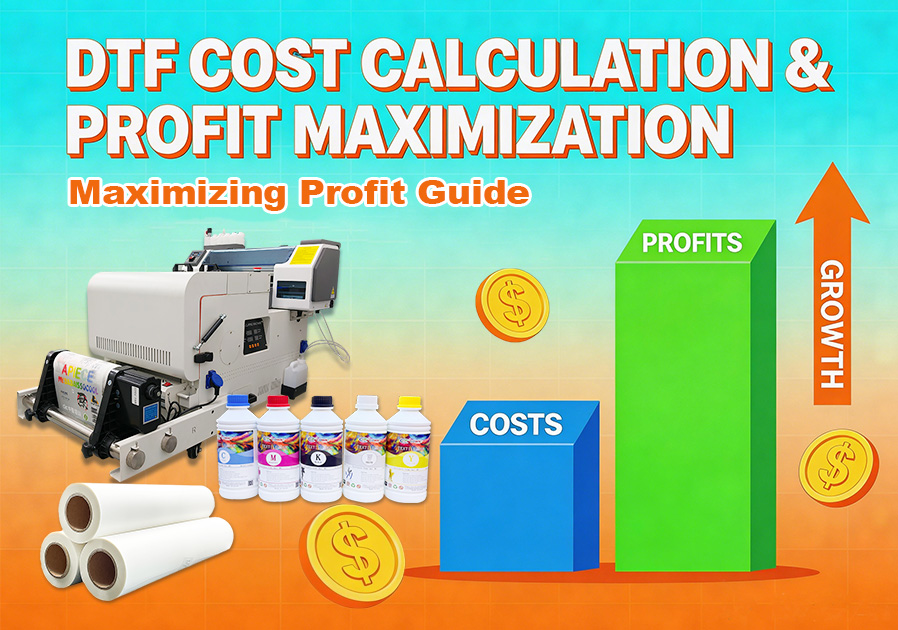
Introduction: A printer is an investment, but knowing how to price is where profit begins.
Many entrepreneurs are drawn to DTF by its low barrier to entry, yet overlook the complexity of cost calculation. DTF‘s cost structure is more complex than it appears — it includes not only obvious equipment purchases but also consumables, maintenance, electricity, and labor. This article provides a comprehensive DTF cost analysis framework to help you develop rational pricing strategies and achieve sustainable profit growth.
1. Initial Investment: How Much Does It Cost to Start?
DTF startup costs can be categorized into three tiers, each serving different business scales and goals:
Entry-Level Setup ($3,000 - $8,000):
DTF Printer: $2,000 - $5,000 (entry-level A4/A3 desktop models)
Heat Press: $300 - $1,500
Powder Shaker: $200 - $500
Curing Oven (optional): $500 - $1,000
Initial Supplies (inks, film, powder): $500 - $1,000
This setup is suitable for startups, home-based operations, and low-volume production, typically producing 5-15 printed shirts per hour. While entry-level printers are attractively priced, they are often slower and have smaller print areas.
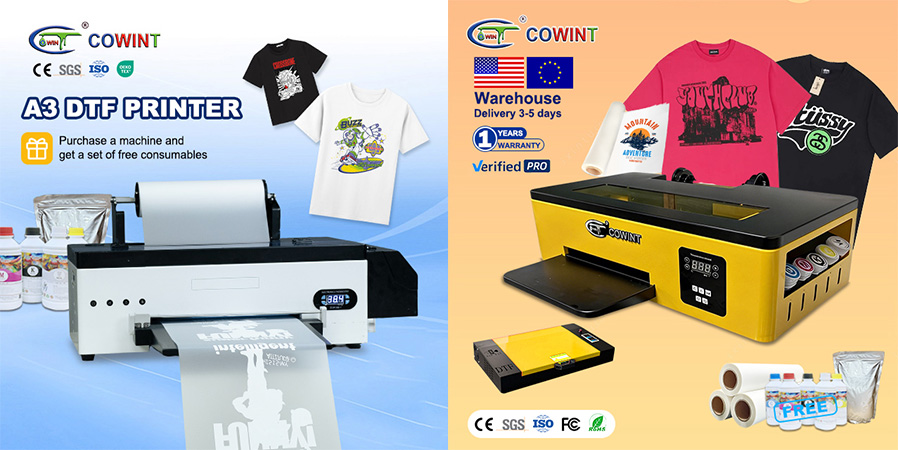
Professional Setup ($10,000 - $25,000):
Industrial DTF Printer: $8,000 - $18,000
Automatic Powder Shaker: $1,500 - $3,000
Conveyor Dryer: $1,500 - $3,000
Professional Heat Press: $1,000 - $2,000
This configuration is ideal for small to mid-sized print businesses with steady order volumes, enabling higher production efficiency and more consistent output quality.
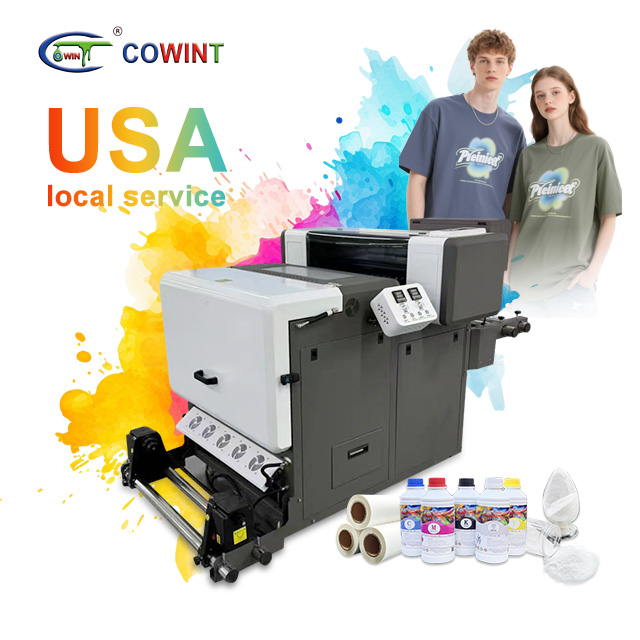
All-in-One Solution (~$10,000):
Some suppliers now offer complete packages including a DTF printer, automatic shaker, curing unit, air purifier, and heat press. While the initial investment is higher, it significantly reduces equipment compatibility complexity and technical barriers.
2. Per-Unit Production Cost: How Much Does Each Print Really Cost?
This is the most important part of any DTF financial model. Using a standard A4/letter-size full-color design as an example, the direct material cost breakdown per print is as follows:
| Cost Component | Estimated Range |
|---|---|
| DTF Film | $0.20 - $1.00 per sheet |
| DTF Ink | $0.10 - $0.80 per print |
| Hot-Melt Powder | $0.05 - $0.25 per print |
| Electricity | $0.02 - $0.10 per print |
| Materials Subtotal | $0.37 - $2.15 per print |
Estimates from various sources align closely: direct material costs per print range from approximately $0.37 to $2.15, depending on design size, ink coverage, and material quality.
Note that these figures represent direct material costs only. The complete total cost also requires consideration of:
Labor Cost: If you‘re operating alone, assign yourself a reasonable hourly rate (e.g., $20/hour). A typical T-shirt from design to completion takes about 15 minutes, equivalent to roughly $5 in labor cost.
Equipment Depreciation and Maintenance: Annual maintenance costs range from $350 to $700, including printhead cleaning, consumable replacement, and potential repairs.
Overhead: Fixed expenses such as rent, utilities, RIP software subscriptions, and insurance need to be allocated across each product.
3. Profit Potential: How Much Can You Earn Monthly?
Based on 2025 industry data, here is a 12-month financial projection for a typical home-based operation (based on producing approximately 400-500 printed T-shirts per month):
| Item | Amount |
|---|---|
| Initial Equipment Investment | ~$10,000 |
| Monthly Material Cost | $300-$800 |
| Monthly Maintenance Cost | $30-$60 |
| Average Selling Price (Printed T-shirt) | $20-$35 |
| Net Profit per Item | $15-$25 |
| Estimated Annual Net Profit | ~$35,000 |
In comparison, outsourcing transfers instead of producing in-house requires lower initial investment (just a ~$300 heat press) but comes with higher per-unit outsourcing costs of $1-$15, reducing annual net profit to approximately $24,000.
Another industry analysis shows that approximately 60% of small printing businesses adopting DTF printers typically reach profitability after selling 400-900 garments — a remarkably attractive return timeline for startups.
4. Pricing Strategy: How to Set Profitable Prices?
Pricing is not simply multiplying cost by a fixed margin. Here is a proven pricing framework:
Step 1: Calculate your total cost. Sum direct material costs, labor costs, equipment depreciation, and overhead to arrive at your total cost per item. Do not omit anything — many beginners overlook “their own time cost,” which often leads to losses.
Step 2: Determine your target margin. Gross profit margins in the DTF printing business typically range from 50% to 70%. This means if your total cost per T-shirt is $10, you should sell it for $20-$30.
Step 3: Consider market competition. Research the market in your region. Printed T-shirts on platforms like Etsy and Amazon typically sell for $20-$35. If your product is positioned at a higher tier (e.g., organic cotton, special techniques, limited designs), you can price accordingly.
Step 4: Adjust pricing by order volume. As with all print businesses, single-item orders command the highest unit price, while bulk orders can receive discounts. Bulk discounts can attract large customers, but ensure the discounted price still covers costs and leaves reasonable profit.
5. Practical Tips for Cost Reduction and Efficiency Improvement
Optimize gang sheet layouts to maximize film utilization. Arrange multiple small designs on a single A3 sheet to minimize film waste — this is the most effective method for improving material efficiency.
Precisely control powder and ink usage. Excess powder or ink not only wastes materials but also results in stiff print feel. Precise control reduces costs while improving product quality.
Perform regular printer maintenance. Preventive maintenance is far cheaper than post-failure repairs. Perform daily nozzle checks and white ink agitation to avoid costly printhead replacements.
Purchase consumables in bulk. Film, ink, and powder are ongoing expenses. Bulk purchasing secures lower unit prices, but pay attention to storage conditions (dark, temperature-controlled, moisture-free).
Evaluate the make vs. buy balance. For occasional large orders or special designs, outsourcing transfers may be more economical than in-house production. Establish a decision framework to flexibly switch between in-house and outsourced production.
(The content of this article is for reference only.)